What's Inside an Asphalt Shingle Roof: Every Layer, From the Rafters Up
Decking, drip edge, underlayment, starter strip, shingles, flashing, vents and ridge cap: what each layer of a shingle roof does and what to ask.
Affordable Roofing TX5 min read
From the street, a roof looks like one thing: shingles. It’s really a system of layers, and each one has a job. When one is missing or done wrong, the rest can’t make up for it.
Here’s every layer of an asphalt shingle roof, from the bottom up, what it does, and what to ask your roofer about it.
The layers at a glance
| Layer | What it does | Replaced with a new roof? |
|---|---|---|
| Rafters or trusses | The frame that holds the roof up | No, unless damaged |
| Decking | The wood surface everything is nailed to | Only damaged sheets |
| Drip edge | Metal trim that sends water off the edges | Yes |
| Underlayment | The waterproof sheet under the shingles | Yes |
| Starter strip | Seals the first row of shingles at the edges | Yes |
| Shingles | Shed rain and take the sun, wind and hail | Yes |
| Flashing and pipe boots | Seal the joints and holes | Yes |
| Ventilation | Lets heat and moisture out of the attic | Brought up to code |
| Ridge cap | Covers the peak | Yes |
1. Rafters or trusses: the frame
The wooden frame that gives your roof its shape. A normal roof replacement doesn’t touch it. If we find sagging, cracks or water damage when the old roof comes off, we show you before anything else happens.
2. Decking: the base
Decking (also called sheathing) is the plywood or OSB board nailed to the frame. Shingles must be fastened to a solid deck, so every sheet needs to be sound.
The catch: nobody can see rot in the decking until the old shingles come off. That’s where surprise charges usually come from. At Affordable Roofing, the first 2 sheets are included in every price. After that it’s $110 a sheet, installed, and we send you a photo of each damaged sheet so you approve it before we replace it. There’s also a cap on how many sheets you’ll ever pay for. See the decking cap.
3. Drip edge: the trim
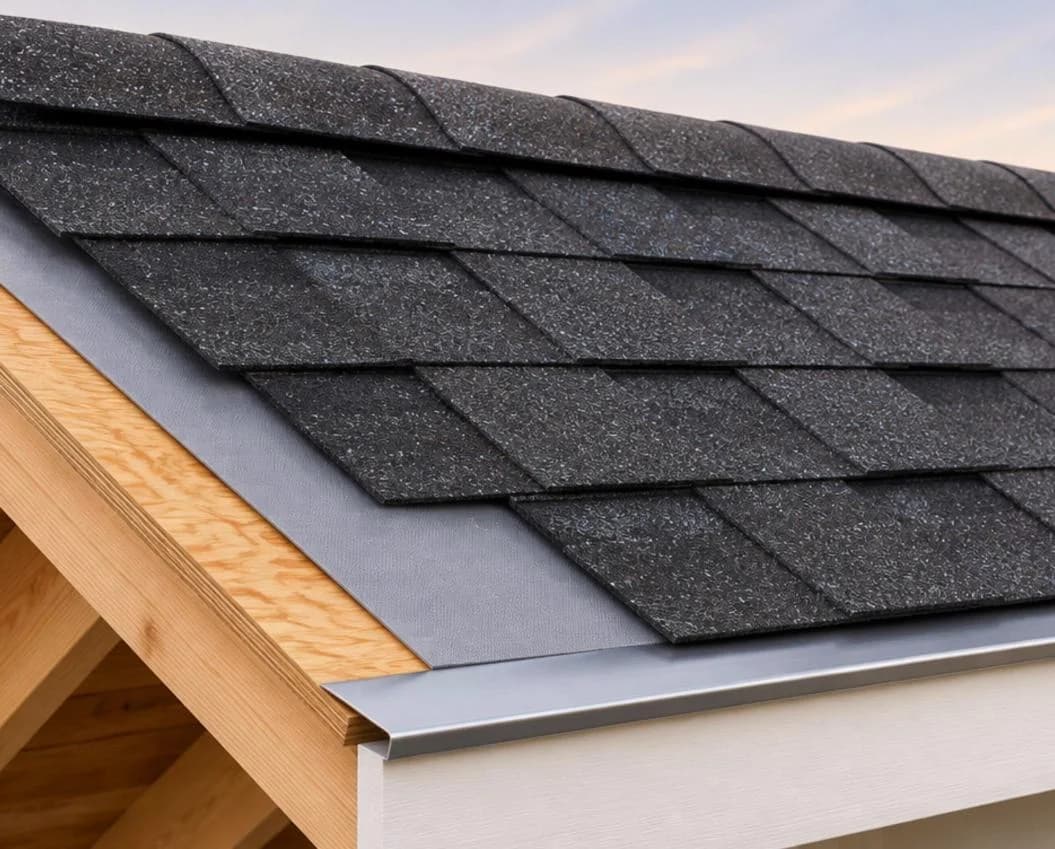
The metal strip along the edges of the roof. It steers water off the roof and into the gutters instead of letting it run behind the fascia and rot the wood.
The building code requires drip edge on both the eaves (the bottom edges) and the rakes (the sloped side edges). The underlayment goes over the drip edge at the eaves and under it at the rakes, so water always flows outward.
4. Underlayment: the second line of defense
A sheet rolled over the whole deck before any shingles go on. It keeps the decking dry during the install, and it keeps water out if wind-driven rain gets under a shingle or a shingle blows off. In Houston, that happens.
There are two main types:
- Asphalt felt (“tar paper”): the traditional choice and the cheapest. It can wrinkle and tear when it gets wet.
- Synthetic: a woven polymer sheet. It’s lighter, stronger and better in high wind, and it doesn’t soak up water.
On low-slope roofs (between 2 and 4 inches of rise per foot), code calls for a double layer of underlayment. Shingles can’t be used at all below 2 inches of rise per foot.
Our Better option upgrades to a tougher synthetic underlayment. Compare the options.
5. Starter strip: the first row
A strip of shingle with a line of sealant, run along the eaves and rakes before the first full row. It seals down the edges of the roof, where wind gets its first grip. Skip it, and the bottom row is the first to lift in a storm.
6. Shingles: the part you see
Shingles shed rain and take the sun, wind and hail. Most Houston homes today get one of these:
- Architectural shingles: thicker, layered shingles with a dimensional look. Our standard.
- Class 4 impact-resistant shingles: built to pass the toughest hail-impact test, UL 2218 Class 4. Many Texas insurers offer a discount for them, so ask yours how much.
How shingles are nailed matters as much as which ones you buy. Code requires at least 4 nails per shingle, or more if the manufacturer calls for it. In high-wind areas, 6 nails per shingle is common. Nails placed too high or too low are one of the main reasons shingles blow off.
7. Flashing and pipe boots: the weak spots
Most leaks don’t start in the middle of a roof. They start where something breaks the surface: a wall, a chimney, a valley, a vent pipe.
- Flashing is bent metal that seals the joint where the roof meets a wall or chimney. Step flashing is woven into each row of shingles along a wall.
- Pipe boots are the rubber collars around plumbing vents. In Texas sun, the rubber cracks long before the shingles wear out.
Every new roof we install gets new flashing and new pipe boots. Reusing old ones to save a few dollars is how a new roof ends up leaking.
8. Ventilation: the part nobody sees
Your attic needs air flowing in at the bottom (soffit or eave vents) and out at the top (ridge or roof vents). Without it, summer heat bakes the shingles from below and humidity rots the decking.
The building code sets a minimum amount of vent opening based on the size of your attic, and a balance between intake and exhaust. We bring every roof we replace up to code, and our Better option adds a fuller ventilation package for Houston heat.
9. Ridge cap: the finish
Thicker shingles folded over the peak and the hips of the roof. The ridge is where wind pulls hardest, so ridge caps are made for it. On many roofs, a ridge vent sits underneath and lets hot air out of the attic.
What every roof from us includes
- Tearing off one layer of old shingles and hauling everything away
- New underlayment
- Starter strips, ridge caps and drip edge
- New pipe boots and new flashing
- Attic ventilation that meets the building code
- The city permit, where one is needed
- Up to 2 sheets of new decking
You see your price range and the most you’ll pay before anyone comes out. No sales pitch.
Sources
- International Code Council: drip edge requirement, IRC R905.2.8.5
- City of Firestone: 2018 IRC reroof requirements
- City of Bloomington: asphalt shingle fasteners
- Fine Homebuilding: synthetic vs. felt underlayment
- Asphalt Roofing Manufacturers Association: ventilation white paper
- GAF: Class 4 insurance discounts in Texas